containerd 1.x 已经没有退路
containerd 1.7 的延长支持在 2026 年 9 月结束,而这段延长支持本来就只覆盖已经停止维护的 Kubernetes 版本。这里讲清楚 version 3 配置重写、会让整个节点起不来的镜像仓库改造,以及唯一值得升到的那个分支。
- containerd
- Kubernetes
- 容器
- Linux
这场迁移有两种读法:一种像待办事项,一种像最后期限,而你落在哪一种,取决于一条脚注。containerd 的版本表把 1.7 分支标为 LTS,支持到 2026 年 9 月,看上去还有余地。下面那条脚注说明,自 2026 年 3 月起这段支持由两位具名维护者提供,并且只面向 Kubernetes 1.32、1.31、1.30 在 Google Kubernetes Engine 上的使用场景,与该场景无关的改动可以被拒绝。Kubernetes 1.32 已于 2026 年 2 月停止维护。如果你不是在 GKE 上跑一套已经停止维护的 Kubernetes,这根救命绳从来就没朝你扔过。
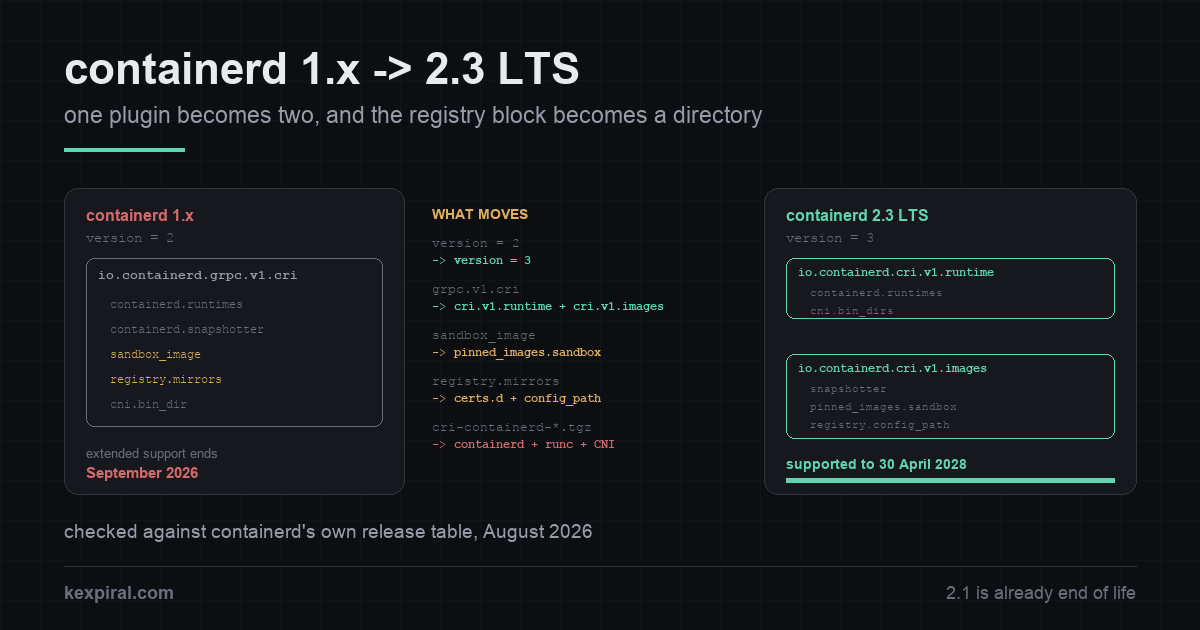
所以这是一场有真实期限的迁移,不该只是在运维手册里把版本号加一就算完事。下面写的是全套:怎么读 containerd 的版本策略而不被 LTS 这个词误导,为什么 2.1 是最糟糕的落脚点,配置从 version 2 到 version 3 的重写与挪了位置的插件 ID,带着自己独有 bug 和独有故障形态的镜像仓库改造,2.1 里悄悄换掉的镜像拉取路径,2.0 删掉的全部内容,一份按节点执行的操作手册,一份关于回滚能救回什么、救不回什么的实话,以及一份出错时返回非零退出码的验证脚本。
这些故障现象,没有一个会提到 containerd
这一类故障没有一个会自报家门说是运行时版本的问题,所以往往查得很晚。一个节点升级后回来,CRI 插件根本没起来:守护进程在跑,systemctl status 是绿的,而节点上每个 Pod 都卡在 ContainerCreating。一个四年来一直从内部镜像源拉的镜像,忽然开始从 Docker Hub 拉,最先被察觉的是出网流量账单。某个团队两年前手工加的 RuntimeClass 解析不到了,只有用它的那些负载会挂。每一种情况里,运行时都在跑,而运行时是错的。[ctrrel]
| 你看到的现象 | 通常意味着什么 | 在哪一节处理 |
|---|---|---|
某个节点上所有 Pod 卡在 ContainerCreating,守护进程却健康 | CRI 插件没有加载。containerd 照样启动,只在自己的日志里报告这个失败 | 镜像仓库 |
| 镜像忽然从公网仓库拉,而不是内部镜像源 | registry.mirrors 块没有活过向 config_path 的重写 | 镜像仓库 |
在没有外网的节点上,pause 容器去拉 registry.k8s.io | sandbox_image 没有被搬到 pinned_images.sandbox | 插件拆分 |
| 只有 gVisor 或 Kata 的负载失败,其余一切正常 | 新配置里缺了某个 RuntimeClass 点名的 runtime handler | Kubernetes |
| 上周还能拉的老镜像,现在报 manifest 错误 | Docker schema 1 拉取:在 containerd 2.0 中默认禁用,在 2.1 中彻底移除 | 移除项 |
| 改了一个没人觉得和拉镜像有关的配置之后,拉取行为变了 | 某个 Transfer Service 无法照办的设置,把节点退回了本地拉取 | 镜像拉取 |
| 守护进程每次启动都记一条 “Configuration migrated from version 2” | 文件从来没有被重写过。是兼容层在扛着它,而镜像仓库那个 bug 就住在这条路径上 | 配置文件 |
共同的线索是:containerd 2.x 对 version 2 的配置文件是刻意宽容的——读进来,在内存里转换,然后照常启动。升级当下这是善意,之后就是负债,因为这意味着迁移可以无限期地停在半途,而没有任何东西逼你收尾。守护进程把抱怨写进日志然后照样启动;没加载成功的插件报了一个错误状态,而没有任何东西会把它端到你面前。从某种意义上说,整篇文章都是在论证一件事:把迁移做完,别让兼容层替你扛着。[ctr20]
把支持周期表读对
先从版本表开始,因为它是唯一能拍板的文档,也是被系统性读错的那一份。containerd 维护两类分支。普通版本支持八个月。每年有一个版本被指定为 LTS,至少支持两年。在这之上,某个分支还可以在常规窗口关闭之后,由具名维护者提供延长支持——同一列里挂着同一个标签,实质上却是另一回事。[ctrrel]
| 分支 | 状态 | 停止维护时间 | 对你意味着什么 |
|---|---|---|---|
| 1.6 | 已停止维护 | 2025 年 8 月 23 日 | 已经一年没有支持。什么都不会再来了,安全修复也一样 |
| 1.7 | LTS,延长支持 | 2026 年 9 月 | 只剩延长支持,由两位具名维护者提供,范围限定在 GKE 上的 Kubernetes 1.30–1.32 |
| 2.0 | LTS,延长支持 | 2027 年 3 月 | 同样的形态:延长支持限定在 GKE 上的 Kubernetes 1.33,而 1.33 本身已停止维护 |
| 2.1 | 已停止维护 | 2026 年 7 月 3 日 | 已经结束。很多人最先升到的就是它,也是最糟糕的停留点 |
| 2.2 | 活跃 | 2026 年 11 月 6 日 | 有补丁,但只剩十周余量。作为中转站可以,作为终点不行 |
| 2.3 | LTS | 2028 年 4 月 30 日 | 目标。当前的长期分支,前面还有将近两年支持 |
| 2.4 | 未来版本 | 暂定 2027 年 4 月 | 一个普通的八个月版本。不能替代 LTS |
接着把 Kubernetes 的支持矩阵叠上去,这是两个项目交汇的地方。containerd 会为每个 Kubernetes 小版本给出一份推荐版本清单。对 Kubernetes 1.36,这份清单写的是 2.3.0+、2.2.0+——完全没有 1.x 的条目。kubelet 里没有任何机制会强制这一点:不受支持的组合照样启动、照样运行、看起来一切正常,直到它不正常,那时候就只剩你自己在排查了。这张矩阵表达的是“测过什么”,而这些测试是你和一个别人没遇到过的运行时 bug 之间唯一的东西。[k8srel]
| Kubernetes | 被列为推荐的 containerd 版本 | Kubernetes 停止维护时间 | 怎么读 |
|---|---|---|---|
| 1.33 | 2.1.0+、2.0.4+、1.7.24+、1.6.36+ | 2026 年 6 月 28 日 | 已经没有支持。containerd 2.0 的延长支持点名的正是这个组合 |
| 1.34 | 2.1.3+、2.0.6+、1.7.28+、1.6.39+ | 2026 年 10 月 27 日 | 只剩两个月,而四个 containerd 选项里有两个——2.1 和 1.6——本身已停止维护 |
| 1.35 | 2.2.0+、2.1.5+、1.7.28+ | 2027 年 2 月 28 日 | 这是 1.x 运行时最后一次出现的那一行 |
| 1.36 | 2.3.0+、2.2.0+ | 2027 年 6 月 28 日 | 没有 1.x 条目。迁移从这一行开始不再是可选项 |
坑里还有一个坑,叫 containerd 2.1。对 2025 年下半年做升级的人来说,它是最顺手的落脚点,很多内部文档到今天还这么写,而它已经在 2026 年 7 月 3 日停止维护——比支持到 2026 年 11 月的 2.2 还早,更远早于当前 LTS、支持到 2028 年 4 月的 2.3。“升到 2.x”不是计划。从零开始只有一个值得瞄准的分支,就是 2.3。
这些节点上到底装了什么
动手之前先把“实际装的是什么”搞清楚,因为在任何规模的机器群里,答案都不会只有一个版本。有三件事要看,而且互相独立:守护进程版本、配置文件版本、以及实际提供给 kubelet 的 CRI API 版本。配置版本是最容易被忽略的,也是唯一可能“缺席”的那个:没有 version 这一行的文件,会被当成 version 1 文件处理。而在这一点上,项目自己的文档互相打架,值得知道分歧在哪:CRI 配置指南说 version 1 已在 containerd 2.0 中被删除,而 RELEASES.md 说缺少版本号时按 version 1 解析,并且所有旧版本都能通过迁移得到支持,源码里也确实还留着一个 v1 的迁移函数。所以对 version 1 的文件,正确的态度是看见就修,而不是指望自己能推断出它到底会怎么被对待。[cfgtoml]
# The daemon, the client and the shim are three separate versions and they are
# allowed to disagree. Ask all three rather than assuming.
containerd --version
# containerd github.com/containerd/containerd/v2 v2.3.2 <revision>
ctr version                        # client and server, side by side
runc --version                     # the OCI runtime is a separate install now

# The configuration version is the single most useful number here. There is no
# `version` line in very old files: absent means version 1, which containerd
# 2.0 removed outright rather than migrating.
head -1 /etc/containerd/config.toml
# version = 2

# What the plugins are doing. A plugin in state "error" is the daemon telling
# you a migration went wrong; it does not stop the daemon from starting.
ctr plugins ls | awk '$4!="ok"'
# TYPE  ID  PLATFORMS  STATUS

# From the Kubernetes side, which is what actually matters:
kubectl get nodes -o custom-columns=\
'NODE:.metadata.name,RUNTIME:.status.nodeInfo.containerRuntimeVersion,'\
'KUBELET:.status.nodeInfo.kubeletVersion,OS:.status.nodeInfo.osImage'
# NODE     RUNTIME                KUBELET   OS
# node-01  containerd://1.7.28    v1.34.9   Ubuntu 24.04.3 LTS

# And the CRI API version the kubelet is really getting. containerd 2.0 removed
# v1alpha2; if anything on this node still speaks it, it stops working here.
crictl version
# RuntimeName:  containerd
# RuntimeApiVersion:  v1
然后去问守护进程,它其实早就想告诉你的事。从 1.6.27 和 1.7.12 起,containerd 就通过 introspection API 暴露废弃告警,目的正是让这场迁移可以被计划,而不是被撞见。子命令是 ctr deprecations list——复数,值得特意说一句,因为至少有一份官方文档把它写成了单数,而那个写法并不存在。用 --format json 在全部节点上跑一遍。它不是健康证明,因为告警是在使用时才产生的:一个自上次重启以来没拉过 schema 1 镜像的节点,不会报出这一条。它是“你已经知道有问题”的那份初始清单。[depsrc]
# containerd has been telling you what will break since 1.6.27 / 1.7.12, through
# the introspection API. Almost nobody reads it, because the warnings go into
# the daemon log rather than anywhere you look. Ask directly.
#
# Note the subcommand is `deprecations`, plural. Some documentation writes it
# in the singular; that form does not exist and returns a usage error.
ctr deprecations list
# ID                                          LAST OCCURRENCE   MESSAGE
# io.containerd.deprecation/pull-schema-1-image  2026-08-24...   Schema 1 image...
# io.containerd.deprecation/cri-registry-mirrors 2026-08-24...   `mirrors` is deprecated...

# Machine-readable, which is the form you want across a fleet:
ctr deprecations list --format json | jq -r '.[].id' | sort -u

# Run it on every node and count, rather than sampling. The warnings are
# emitted on use, so a node that has not pulled a schema 1 image since the last
# daemon restart will not report one - which is why this is a starting point
# and not a clean bill of health.
for n in $(kubectl get nodes -o name); do
  printf '%-22s ' "${n#node/}"
  kubectl debug "$n" -it --image=busybox --profile=general -- \
    chroot /host ctr deprecations list --format json 2>/dev/null \
    | jq -r '[.[].id] | join(",")' || echo '(unavailable)'
done

# Clean up afterwards. `kubectl debug node/...` names its pods
# node-debugger-<node>-<suffix> and applies no label of its own, so there is
# nothing to select on - match the name instead, or they accumulate silently.
kubectl get pods -n default -o name | grep '^pod/node-debugger-' | xargs -r kubectl delete
配置文件,从 version 2 到 version 3——现在还有 version 4
配置文件是这场迁移的主体,而第一件要弄清楚的事是“最新版本”到底指哪一个,因为它在今年又往前挪了一格。version 3 随 containerd 2.0 到来,把 CRI 插件一分为二的正是它。version 4 随 2.3 到来,做的是另一件事,下一节专门讲。version 2 至今仍然会被读取,并在每次启动时于内存中转换——守护进程会为此在日志里留下一行,这是判断一个节点究竟是真的迁移过、还是只是被兼容层收留着的最省事的办法。守护进程自带一个转换器 containerd config migrate,它读你当前的文件,把最新版本的内容打到标准输出。man 手册里没有它——containerd-config(8) 只写了 default——这在很大程度上解释了为什么这么少人知道它存在。[cricfg][cfgsrc]
# containerd 2.x reads a version 2 file and converts it in memory on every start.
# That is a compatibility shim, not a plan: it costs startup time, it is where
# the registry bug below lives, and the daemon says so on every boot.
journalctl -u containerd | grep -m1 'Configuration migrated from version'
# Configuration migrated from version 2, use `containerd config migrate` to
# avoid migration

# `containerd config migrate` reads your current file and prints the LATEST
# version on stdout. It is not in the man page - only `default` is - but it has
# been in the binary since 2.0.
#
# Note which version "latest" means, because it moved. Version 3 arrived in
# containerd 2.0 and is the one that split the CRI plugin in two. Version 4
# arrived in 2.3 and moves the server sockets into plugins (see below).
containerd config migrate > /tmp/config.new.toml
head -1 /tmp/config.new.toml
# version = 4        <- on containerd 2.3. On 2.0-2.2 this says 3.

# Two things to know before you trust the output. First, `migrate` and `dump`
# share one implementation, so the result is the FULLY POPULATED configuration,
# defaults and all - not a minimal file. Every default you did not choose is now
# pinned in your file and stops following the daemon when upstream changes it.
wc -l /etc/containerd/config.toml /tmp/config.new.toml
#   41 /etc/containerd/config.toml
#  318 /tmp/config.new.toml

# Second, and this is upstream's own warning: migrating the file to the latest
# version limits which containerd versions can read it. A version 4 file needs
# 2.3.0 or newer. If you might want to roll the binary back tonight, write a
# version 3 file instead - 2.0 and later read it, and it still gets you the
# plugin split, which is the part that matters.

# So: use the output to learn the new names, then hand-write the short version.
# What did it actually change? Compare the keys, not the files.
grep -oE '^\s*\[[^]]+\]' /tmp/config.new.toml | tr -d ' []' | sort > /tmp/new.keys
grep -oE '^\s*\[[^]]+\]' /etc/containerd/config.toml | tr -d ' []' | sort > /tmp/old.keys
diff -u /tmp/old.keys /tmp/new.keys

# Validate before you restart anything. `config dump` loads the file the daemon
# would load, including everything pulled in by `imports`, and fails loudly on
# a file it cannot parse. Note that --config is a global flag: it goes BEFORE
# the subcommand. Putting it after `config dump` is a usage error, not a check -
# urfave/cli rejects it with "flag provided but not defined: -config".
containerd --config /tmp/config.new.toml config dump >/dev/null && echo 'parses'

# Keep the old one. It is the fastest rollback you have.
cp -a /etc/containerd/config.toml /etc/containerd/config.toml.v2.bak在把它的输出直接盖到线上配置之前,有两件事要知道。第一,migrate 和 dump 走的是同一条代码路径,所以返回的是完整展开的配置:守护进程的每一个默认值都被显式写出来。四十行的文件会变成三百行,而每一个你从没选过的默认值,现在都被钉死在你的文件里,上游改动时它不会跟着走。用它的输出去学新的键名,然后自己手写那份短的。第二,在重启任何东西之前先校验候选文件——但要注意 --config 是全局参数而不是子命令参数,所以它得写在 config dump 之前,也就是 containerd --config <文件> config dump;写在后面不是校验,而是一个用法错误。写对了,它就会按守护进程的方式加载文件、跟进 imports,遇到解析不了的东西明确报错——这比在一个起不来的节点上发现拼写错误要好得多。[cfgman]
# Configuration version 4 (containerd 2.3 and later). It changes nothing about
# CRI: the whole of the plugin split above is version 3 work. What it moves is
# the daemon's own sockets, out of top-level tables and into server plugins.

# --- version 3 and earlier -------------------------------------------------
#   [grpc]
#     address = "/run/containerd/containerd.sock"
#     uid = 0
#     gid = 0
#   [ttrpc]
#     address = "/run/containerd/containerd.sock.ttrpc"
#   [metrics]
#     address = "127.0.0.1:1338"
#   [debug]
#     address = "/run/containerd/debug.sock"
#     level = "info"

# --- version 4 -------------------------------------------------------------
version = 4

[plugins.'io.containerd.server.v1.grpc']
  address = '/run/containerd/containerd.sock'
  uid = 0
  gid = 0

[plugins.'io.containerd.server.v1.ttrpc']
  address = '/run/containerd/containerd.sock.ttrpc'

[plugins.'io.containerd.server.v1.metrics']
  address = '127.0.0.1:1338'

[plugins.'io.containerd.server.v1.debug']
  address = '/run/containerd/debug.sock'

# `[debug]` does not disappear: level, format and log_trace_id stay at the top
# level. Only the socket fields move.
#
# One behaviour change hides in here. Before version 4, an unset ttrpc address
# was derived from the grpc address as "<grpc address>.ttrpc" and inherited its
# uid and gid. In version 4 the ttrpc plugin is independent and falls back to
# its own default. If anything of yours connects to that socket by path -
# a shim debugger, a monitoring agent - set it explicitly rather than assuming.
version 4 值得单独看一眼,因为几乎所有谈这场迁移的文章都停在 version 3,也因为它带着一条回滚上的约束。它对 CRI 没有任何改动:它把守护进程自己的 socket 从顶层的 [grpc]、[ttrpc]、[metrics]、[debug] 表里挪了出来,放进 io.containerd.server.v1.* 这组插件。由此带来两个后果。行为上的那个:在 version 4 之前,没有显式设置的 ttrpc 地址是从 gRPC 地址推导出来的,形如 <grpc address>.ttrpc,并继承它的 uid 和 gid;而在 version 4 里,ttrpc 插件是独立的,会回落到它自己的默认值——所以你手上任何按路径连这个 socket 的东西,现在都应该把地址显式写出来。操作上的那个是上游自己的提醒:把文件迁到最新版本,会缩小能读懂它的 containerd 版本范围。version 4 的文件需要 2.3.0 或更新的版本,而 version 3 的文件从 2.0 起都能读。如果你的方案里包含“当晚就能把二进制换回去”,那就写 version 3——插件拆分这个真正要紧的部分,你照样拿到了。[cfgver][srvmig]
一个插件拆成两个,配置项也跟着挪了
结构上的变化是:原本唯一的 CRI 插件被拆成了两个。io.containerd.grpc.v1.cri 过去装着所有东西;在 version 3 里它只剩流式服务器的选项,实质内容搬到了两个新的 ID 下:io.containerd.cri.v1.runtime 管一切与“跑容器”有关的东西——runtimes、CNI、sandbox、SELinux、OOM 处理;io.containerd.cri.v1.images 管一切与镜像有关的东西——snapshotter、镜像仓库、被固定的 sandbox 镜像、拉取并发。这个划分比原来的好,同时也意味着:对插件 ID 做机械式查找替换,会把你大约一半的配置项放进错误的表里。[ctrarch]
# /etc/containerd/config.toml - containerd 1.7, the file most clusters have.
# Everything lives under one plugin ID: io.containerd.grpc.v1.cri
version = 2

[plugins."io.containerd.grpc.v1.cri"]
  sandbox_image = "registry.k8s.io/pause:3.10"

  [plugins."io.containerd.grpc.v1.cri".containerd]
    snapshotter = "overlayfs"
    default_runtime_name = "runc"

    [plugins."io.containerd.grpc.v1.cri".containerd.runtimes.runc]
      runtime_type = "io.containerd.runc.v2"
      [plugins."io.containerd.grpc.v1.cri".containerd.runtimes.runc.options]
        SystemdCgroup = true

    [plugins."io.containerd.grpc.v1.cri".containerd.runtimes.gvisor]
      runtime_type = "io.containerd.runsc.v1"

  [plugins."io.containerd.grpc.v1.cri".cni]
    bin_dir = "/opt/cni/bin"
    conf_dir = "/etc/cni/net.d"

  # The block that causes the most trouble in this migration.
  [plugins."io.containerd.grpc.v1.cri".registry]
    [plugins."io.containerd.grpc.v1.cri".registry.mirrors."docker.io"]
      endpoint = ["https://mirror.internal.example.com"]
# /etc/containerd/config.toml - containerd 2.x. The single CRI plugin has been
# split in two, and the settings moved with the split: anything about running
# containers is now under io.containerd.cri.v1.runtime, anything about images
# under io.containerd.cri.v1.images. io.containerd.grpc.v1.cri still exists,
# but only for the streaming server options.
version = 3
[plugins.'io.containerd.cri.v1.images']
snapshotter = 'overlayfs' # moved: was under ...cri.containerd
[plugins.'io.containerd.cri.v1.images'.pinned_images]
sandbox = 'registry.k8s.io/pause:3.10.2' # replaces sandbox_image
[plugins.'io.containerd.cri.v1.images'.registry]
config_path = '/etc/containerd/certs.d' # replaces the mirrors block
[plugins.'io.containerd.cri.v1.runtime']
[plugins.'io.containerd.cri.v1.runtime'.containerd]
default_runtime_name = 'runc'
[plugins.'io.containerd.cri.v1.runtime'.containerd.runtimes.runc]
runtime_type = 'io.containerd.runc.v2'
[plugins.'io.containerd.cri.v1.runtime'.containerd.runtimes.runc.options]
SystemdCgroup = true
[plugins.'io.containerd.cri.v1.runtime'.containerd.runtimes.gvisor]
runtime_type = 'io.containerd.runsc.v1'
[plugins.'io.containerd.cri.v1.runtime'.cni]
bin_dirs = ['/opt/cni/bin'] # bin_dir is deprecated since 2.1: plural now
conf_dir = '/etc/cni/net.d'
# Note what is NOT here: no registry.mirrors alongside config_path. Setting
# both is an error - "`mirrors` cannot be set when `config_path` is provided" -
# and the CRI plugin refuses to load rather than picking one.
#
# And note the clock on the old keys. registry.mirrors and registry.configs
# were deprecated in containerd 1.5, registry.auths in 1.3, and cni.bin_dir in
# 2.1. All four carry the same removal target: containerd 2.4. Converting them
# is not housekeeping you can defer past the next release.| containerd 1.x(version 2) | containerd 2.x(version 3) | 说明 |
|---|---|---|
version = 2 | version = 3(2.0)/ version = 4(2.3) | version 2 仍会被读取并在内存中转换。version 4 的文件需要 2.3.0 或更新的版本 |
plugins."io.containerd.grpc.v1.cri" | plugins.'io.containerd.cri.v1.runtime' | 一切与跑容器有关:runtimes、CNI、SELinux、OOM、sandbox |
plugins."io.containerd.grpc.v1.cri" | plugins.'io.containerd.cri.v1.images' | 一切与镜像有关:snapshotter、镜像仓库、固定镜像、拉取设置 |
plugins."io.containerd.grpc.v1.cri" | plugins.'io.containerd.grpc.v1.cri' | 仍然存在,但只保留流式服务器的选项 |
sandbox_image = "…" | pinned_images.sandbox = '…' | 改名并搬家。丢了它,离线节点就会去找 registry.k8s.io |
…cri".containerd.snapshotter | …cri.v1.images'.snapshotter | 换了一侧,从运行时挪到镜像 |
…cri".containerd.runtimes.* | …cri.v1.runtime'.containerd.runtimes.* | 只是路径变化。runtime_type = io.containerd.runc.v2 不变 |
…cri".registry.mirrors | …cri.v1.images'.registry.config_path | 机制不同。是一个装着 hosts.toml 的目录,不是一张表。移除目标 2.4 |
…cri".registry.auths | —(imagePullSecrets) | 刻意没有替代品。凭据交给集群管。移除目标 2.4 |
…cri".cni.bin_dir | …cri.v1.runtime'.cni.bin_dirs | 复数,而且是一个列表。2.1 起废弃,移除目标 2.4 |
plugin_dir(Go 插件 .so) | —(proxy 或二进制插件) | 已经在 2.1 中移除,不只是废弃 |
这次拆分里有两处改名造成了大部分损失。sandbox_image 变成了 pinned_images.sandbox,于是原本把 pause 镜像指向内部镜像源的集群,会悄无声息地退回 registry.k8s.io——在节点还能出网的日子里毫无问题。另一处是 snapshotter,它从运行时那一侧挪到了镜像那一侧,反直觉到值得去核对而不是想当然。下表里其余的条目都只是路径变化,不是行为变化。[ctrplug]
镜像仓库:真正会让集群趴下的那一段
镜像仓库配置是这场迁移从“繁琐”变成“有风险”的地方,而且它带着日期:mirrors 和 configs 在 containerd 1.5 中被废弃,auths 在 1.3 中被废弃,三者的移除目标都是 containerd 2.4——也就是本文推荐的那个版本的下一个版本。前两个的替代品是一棵目录树:在单个 config_path 之下,每个仓库主机命名空间一个子目录,各自放一个 hosts.toml。文件更多,魔法更少,而且确实更好用:多个 host 按顺序尝试,capabilities 是显式写出来的,每个仓库自己的 CA 只是文件里的一行而不是一个特例。第三个属性 auths 故意没有对应的文件写法:凭据应该放进 Kubernetes 的 imagePullSecret,而不是放在一份节点级配置里,让这台机器上的每个负载都继承它。[crireg][hosts]
# The mirrors / configs / auths properties are deprecated. The replacement is a
# directory of hosts.toml files, one per registry host namespace, pointed at by
# a single config_path. It is more files and considerably less magic.

# Directory naming, which is where this goes wrong silently. containerd looks
# for the host namespace in three forms, in order:
#     <host>_<port>_        e.g. registry.internal.example.com_5000_
#     <host>:<port>         e.g. registry.internal.example.com:5000
#     _default
# The first form is the portable one - a colon is not a legal filename on
# Windows - so prefer it. A directory named anything else looks perfectly
# correct and simply never matches.

mkdir -p /etc/containerd/certs.d/docker.io
cat > /etc/containerd/certs.d/docker.io/hosts.toml <<'TOML'
server = "https://docker.io"

[host."https://mirror.internal.example.com"]
  capabilities = ["pull", "resolve"]

# Fall through to the real registry if the mirror does not have the layer.
# Order matters: hosts are tried top to bottom.
[host."https://registry-1.docker.io"]
  capabilities = ["pull", "resolve"]
TOML

# A private registry on a port, with its own CA:
mkdir -p /etc/containerd/certs.d/registry.internal.example.com_5000_
cat > /etc/containerd/certs.d/registry.internal.example.com_5000_/hosts.toml <<'TOML'
server = "https://registry.internal.example.com:5000"

[host."https://registry.internal.example.com:5000"]
  capabilities = ["pull", "resolve", "push"]
  ca = "/etc/containerd/certs.d/internal-ca.crt"
TOML

# registry.auths has no file equivalent, on purpose. Credentials belong in a
# Kubernetes imagePullSecret, not in the node's runtime configuration where
# every workload on the node inherits them.
kubectl create secret docker-registry regcred \
  --docker-server=registry.internal.example.com:5000 \
  --docker-username=ci --docker-password="$REG_PASSWORD"

# Verify resolution without restarting anything. --hosts-dir makes ctr read the
# same tree the CRI plugin will read.
ctr images pull --hosts-dir /etc/containerd/certs.d docker.io/library/alpine:3.22

# And confirm the daemon agrees once it has restarted:
containerd config dump | grep -A3 "cri.v1.images'.registry"
# config_path = '/etc/containerd/certs.d'
这个 bug 值得把话说准,因为不准的那个版本会把你带去错的地方翻。它并不要求你写过什么奇怪的东西。拿一份普通的 version 2 文件,里面只有一个 registry.mirrors 块,别的什么都没有,用它启动 containerd 2.2.0——内存里的迁移会在旁边补上默认的 config_path,而 CRI 插件对这种组合直接拒绝:`mirrors` cannot be set when `config_path` is provided。插件加载不了。守护进程照样启动。所有调度到这个节点的 Pod 随即创建失败,而这台机器上每个服务的顶层状态都还是绿的。你拿这两个键去 grep 自己的文件,什么也找不到,因为其中一个根本不是你写的。该问题是针对 2.2.0 报告的,修复在 pull request 12617 中,它在 2.3.0 之前合入,并被回合到 2.2 分支——所以在当前的 2.3 或较新的 2.2 补丁版上你不受影响,在 2.0 或 2.1 上则会中招。无论哪种情况,都成立的那条指令是把改造做完:建好 certs.d 目录树,把 config_path 指过去,然后删掉 mirrors 块,别给迁移留下需要猜的余地。[iss12612][pr12617]
镜像拉取的路径在你不知道的时候变了
从 containerd 2.1 起,CRI 插件通过 Transfer Service 拉取镜像,而不再在自己的进程里拉。这是默认行为,不是你打开的开关,单看这一点也没什么特别。值得单开一节的是它的回退机制:如果 CRI 的镜像配置里有 Transfer Service 无法照办的设置,containerd 会为整个节点设上 use_local_image_pull 并记一条警告。它不报错,不在使用现场告诉你,也不告诉集群。[ctrxfer]
# Since 2.1 the CRI plugin pulls images through the Transfer Service instead of
# pulling in-process. This is not a flag you set; it is the default. What makes
# it worth knowing is the fallback: if the CRI image configuration contains
# anything the Transfer Service cannot honour, containerd silently switches the
# whole node back to local pull and logs a warning.
#
# The triggers, from the CRI config guide:
#   Registry.Mirrors set          Registry.Configs set      Registry.Auths set
#   MaxConcurrentDownloads != 3   DiscardUnpackedLayers = true
#   ImagePullWithSyncFs = true    DisableSnapshotAnnotations = false
#
# Which means the perfectly reasonable act of raising the download concurrency
# quietly changes the code path your images are pulled through.

journalctl -u containerd --since '10 min ago' \
  | grep -iE 'transfer|use_local_image_pull|falling back'

# If you want local pull, ask for it rather than triggering it by accident:
#   [plugins.'io.containerd.cri.v1.images']
#     use_local_image_pull = true
#
# If you want the Transfer Service, move the settings to where it reads them:
#   [plugins.'io.containerd.transfer.v1.local']
#     max_concurrent_downloads = 6

# Check which path a real pull took, end to end:
crictl pull registry.k8s.io/pause:3.10.2
crictl images | head
ctr -n k8s.io images ls | wc -l| 设置项 | 本地拉取 | Transfer Service(2.1 起默认) |
|---|---|---|
snapshotter | 支持 | 支持 |
ImagePullProgressTimeout | 支持 | 支持 |
PinnedImages | 支持 | 支持 |
Registry.Mirrors / Configs / Auths | 支持(均已废弃) | 不支持——会触发回退到本地拉取 |
MaxConcurrentDownloads | 从 CRI 镜像配置读取 | 必须挪到 plugins.'io.containerd.transfer.v1.local';非 3 的取值都会触发回退 |
DiscardUnpackedLayers | 支持 | 不支持——触发回退 |
ImagePullWithSyncFs | 支持 | 不支持——触发回退 |
DisableSnapshotAnnotations | 支持 | 改在 snapshotter 插件里配置;取 false 会触发回退 |
把触发列表读一遍,含义就很清楚了:把 max_concurrent_downloads 从 3 调到 6——在带宽好的节点上是再正常不过的做法——就会把这个节点上所有的镜像拉取切到另一条代码路径。保留那个已废弃的 mirrors 块也是同样效果,这是“把镜像仓库改造做完而不是搁一半”的第二个理由。如果你要的是本地拉取,就把 use_local_image_pull = true 写明白。如果你要的是 Transfer Service,就把并发设置挪到真正会读它的 [plugins.'io.containerd.transfer.v1.local'] 下面。[cricfg]
真正被删掉的东西
接下来是移除项,也就是真正消失、而不只是改名的那部分。清单很短,上面每一项也都有文档写明的替代品,但要去读版本号,别读摘要——containerd 2.0 的迁移文档和 RELEASES.md 在两处对不上,而两次被人引用的都是迁移文档。Docker schema 1 拉取是其中要紧的一例:它在 2.0 中被禁用,当时还有一个环境变量能把它打开;在 2.1 中被移除,此后什么都打不开它。既然这里的目标是 2.3,就当它已经没了。这一点之所以要紧,是因为还停留在 schema 1 的镜像,按定义就是大约 2017 年以后没人重新构建过的镜像,也就意味着没人手上还有那份 Dockerfile。要在升级前找出来,不要升级后再找:从 1.7.8 和 1.6.25 起,转换过的镜像带有一个标签,可以据此检索。[ctr20][ctrrelmd]
# Docker schema 1 manifests. Get the timeline right, because it decides whether
# you have a workaround or a deadline:
#   containerd 2.0  pulling is DISABLED by default, and the environment variable
#                   CONTAINERD_ENABLE_DEPRECATED_PULL_SCHEMA_1_IMAGE=1 re-enables it
#   containerd 2.1  support REMOVED. The variable does nothing. So does anything else.
# Since 2.3 is the target, treat this as removed and find the images NOW.
#
# Since 1.7.8 / 1.6.25 converted images carry a label, so they are findable:
ctr namespaces list --quiet | xargs -I{} -- \
  ctr --namespace={} image list \
    'labels."io.containerd.image/converted-docker-schema1"'

# On a node still running 1.7, the same list from the CRI side:
crictl images -o json | jq -r '.images[].repoTags[]' | sort -u > /tmp/node-images.txt

# For each one, ask the registry what media type it actually serves. A schema 1
# manifest answers with application/vnd.docker.distribution.manifest.v1+prettyjws.
# Anything that does needs rebuilding in schema 2 or OCI before the node moves.

# The runtime v1 shims were removed in 2.0. Anything still asking for them
# fails to start the container, with an error about an unknown runtime:
grep -rn 'io.containerd.runtime.v1.linux\|io.containerd.runc.v1' \
  /etc/containerd/ /etc/crio/ 2>/dev/null
kubectl get runtimeclass -o custom-columns=NAME:.metadata.name,HANDLER:.handler

# The AUFS snapshotter was removed. Almost nobody sets this, and the ones who
# do have a kernel from 2016 underneath it:
containerd config dump | grep -E "snapshotter\s*=" | sort -u

# LimitNOFILE is no longer set in the reference unit. On systemd 240 and newer
# the default is fine; below that the kernel default of 4096 applies, and
# containers inherit it.
systemctl show containerd -p LimitNOFILE -p LimitNOFILESoft
systemctl --version | head -1| 功能 | 废弃于 | 移除于 | 改用什么 |
|---|---|---|---|
Runtime V1,io.containerd.runtime.v1.linux | 1.4 | 2.0 | io.containerd.runc.v2 |
Runc V1,io.containerd.runc.v1 | 1.4 | 2.0 | io.containerd.runc.v2 |
| 内置的 AUFS snapshotter | 1.5 | 2.0 | overlayfs |
containerd.io/restart.logpath 标签 | 1.5 | 2.0 | containerd.io/restart.loguri |
cri-containerd-*.tar.gz 合并包 | 1.6 | 2.0 | 分别安装 containerd、runc 和 CNI 插件 |
CRI v1alpha2 API | 1.7 | 2.0 | 只剩 CRI v1。确认 crictl version 报告 RuntimeApiVersion: v1 |
| 旧的 CRI podsandbox 实现 | 2.0 | 2.0 | sandbox 控制器,也就是现在的默认值 |
| 拉取 Docker schema 1 镜像 | 1.7 | 2.1(2.0 中默认禁用) | 用 schema 2 / OCI 重新构建。环境变量这条后门在 2.1 中失效 |
Go 插件库(*.so)形式的运行时插件 | 2.0 | 2.1 | 改用外部插件:proxy 或二进制 |
参考单元文件里显式的 LimitNOFILE | — | 2.0 | 用 systemd 默认值;低于 systemd 240 的机器手工设回 1024:524288 |
默认 seccomp 配置里的 io_uring_* | — | 2.0 | 显式的 seccomp profile,以及一次“是否真要给它”的讨论 |
有一处移除比其余的都安静,值得点名。参考用的 containerd.service 单元不再显式设置 LimitNOFILE。containerd 的 rlimit 会被它启动的容器继承,所以这并不是只影响守护进程的设置:在 systemd 240 及以后,默认值是合理的,这件事没有影响;在更早的版本上,生效的是内核默认值 4096,而这台机器上的每个容器都会继承它。上游对这类主机的建议是把 LimitNOFILE=1024:524288 手工加回去。[pr8924][sdexec]
没打招呼就翻面的默认值
除了移除项之外,还有几个默认值换了取值。正是它们让一个“你一个配置都没改”的升级之后表现不同,所以对每一条都该明确做个决定,而不是默认照单全收。[ctr20]
| 默认值 | containerd 1.x | containerd 2.x | 为什么重要 |
|---|---|---|---|
enable_unprivileged_ports | false | true | 容器无需 CAP_NET_BIND_SERVICE 即可绑定 1024 以下端口 |
enable_unprivileged_icmp | false | true | ping 无需 CAP_NET_RAW 即可工作 |
enable_cdi | 关闭 | true | /etc/cdi 和 /var/run/cdi 下的 spec 文件可描述设备访问。这个开关本身在 2.2 中废弃,2.4 中消失 |
| NRI | 禁用 | 启用 | NRI socket 成为节点攻击面的一部分 |
| 带 sandbox 的 CRI | 旧的 CRI server | sandbox 控制器 | 用 runc 时看不出来,用 Kata 和 gVisor 时值得先测 |
| 镜像拉取路径 | 进程内拉取 | Transfer Service(2.1 起) | 在若干设置下会静默回退到本地拉取 |
io_uring_* 系统调用 | 允许 | 阻止 | 在反复出现内核漏洞后被移出默认 seccomp 白名单 |
| sandbox 镜像 | sandbox_image | pinned_images.sandbox | 值相同,键不同。重写时很容易丢 |
- 非特权端口和 ICMP 默认打开。CRI 插件现在会为既不使用宿主网络命名空间、也不使用用户命名空间的容器设置
net.ipv4.ip_unprivileged_port_start=0和net.ipv4.ping_group_range=0 2147483647。绑定 1024 以下的端口不再需要CAP_NET_BIND_SERVICE,ping也不再需要CAP_NET_RAW。方便,同时也是容器安全姿态的变化——把enable_unprivileged_ports和enable_unprivileged_icmp设为false就能恢复旧行为。 - NRI 默认启用。Node Resource Interface 允许插件在容器创建时修改容器。访问控制靠的是对系统级 NRI socket 的访问权限,也就是说无论你是否真的跑了哪怕一个 NRI 插件,这个 socket 已经成为节点攻击面的一部分。
- CDI 默认启用,而这个开关本身也快没了。Container Device Interface 处于开启状态,
cdi_spec_dirs默认指向/etc/cdi和/var/run/cdi,所以任何能往这两个目录写 spec 文件的东西,都能为容器描述设备访问。要注意enable_cdi这个开关在 containerd 2.2 中已被废弃,移除目标是 2.4,之后 CDI 就是一直开着——如果你的打算是把它关掉,那个打算是有保质期的。 - io_uring 不再在默认 seccomp 白名单里。
io_uring_enter、io_uring_register和io_uring_setup在一连串内核漏洞之后被移出白名单,项目认为默认放行不再安全。围绕 io_uring 构建的负载需要一份显式的 profile——以及一次“它是否应该拥有这份 profile”的讨论。 - 带 sandbox 的 CRI 实现成为默认。CRI 插件使用稳定的 sandbox 控制器,而不是旧的 CRI server。正常运行时这完全看不出来;跑 Kata 或 gVisor 这类带 sandbox 的运行时时非常明显——而这恰恰是全量铺开之前该测的场景。
以上没有一条是不升级的理由。它们是“先升一个节点、看一看、然后才把改动写进镜像构建”的理由——这就是一场迁移和一次全机群意外之间的区别。[ctrnri][cdi]
单节点升级,按顺序来
机械操作的部分很短,变化更多在做法上而不在内容上。合并包 cri-containerd-cni-VERSION-OS-ARCH.tar.gz 在 2.0 中被移除,因此 containerd、runc 和 CNI 插件现在是三次独立安装、三个独立的版本决定。这更显式,也稍微多点活,同时消除了一个存在多年的混淆来源:过去有人升级 containerd 的同时不知不觉把 runc 也升了。关于这一跳本身有一点可以放心:containerd 支持相邻小版本之间的升级,也单独支持相邻 LTS 版本之间的直接升级——而 1.7(LTS)到 2.3(LTS)正是它自己的发布文档给出的例子。你并没有跳过任何本该落脚的地方。[ctrstart]
#!/usr/bin/env bash
# One node, from containerd 1.7 to 2.3 LTS. Run it on a drained node.
#
# 1.7 -> 2.3 is a supported jump. containerd supports sequential minor upgrades
# and, separately, direct upgrades between sequential LTS releases - and it
# names 1.7 (LTS) to 2.3 (LTS) as an example. That is exactly this path.
set -euo pipefail
VER=2.3.4                 # check https://containerd.io/releases/ before pinning
RUNC_VER=1.5.0
CNI_VER=1.9.1
ARCH=amd64

# 0. Get the workloads off, and keep the node out of rotation until verified.
#    (From the control plane, not from the node.)
#    kubectl drain node-01 --ignore-daemonsets --delete-emptydir-data

# 1. Back up everything the daemon owns. /var/lib/containerd is the image and
#    snapshot store; losing it means re-pulling every image on the node.
systemctl stop kubelet containerd
cp -a /etc/containerd/config.toml /etc/containerd/config.toml.bak
tar -C /var/lib -czf "/var/backups/containerd-lib-$(date +%F).tgz" containerd

# 2. Install the three components separately. The combined
#    cri-containerd-cni-*.tar.gz bundles were removed in 2.0; this is now the
#    supported route rather than a workaround.
curl -fsSLO "https://github.com/containerd/containerd/releases/download/v${VER}/containerd-${VER}-linux-${ARCH}.tar.gz"
curl -fsSLO "https://github.com/containerd/containerd/releases/download/v${VER}/containerd-${VER}-linux-${ARCH}.tar.gz.sha256sum"
sha256sum -c "containerd-${VER}-linux-${ARCH}.tar.gz.sha256sum"
tar -C /usr/local -xzf "containerd-${VER}-linux-${ARCH}.tar.gz"

#    runc and the CNI plugins, pinned deliberately rather than left behind.
#    These used to ride along inside the removed bundles; now they are yours
#    to choose, which also means yours to forget.
curl -fsSL -o /usr/local/sbin/runc \
  "https://github.com/opencontainers/runc/releases/download/v${RUNC_VER}/runc.${ARCH}"
chmod 755 /usr/local/sbin/runc

mkdir -p /opt/cni/bin
curl -fsSLO "https://github.com/containernetworking/plugins/releases/download/v${CNI_VER}/cni-plugins-linux-${ARCH}-v${CNI_VER}.tgz"
tar -C /opt/cni/bin -xzf "cni-plugins-linux-${ARCH}-v${CNI_VER}.tgz"

# 3. Refresh the systemd unit from the release, then reapply any drop-in of
#    your own. Note the reference unit no longer sets LimitNOFILE, and that the
#    directory does not exist on a host that came from a distribution package.
mkdir -p /usr/local/lib/systemd/system
curl -fsSL -o /usr/local/lib/systemd/system/containerd.service \
  "https://raw.githubusercontent.com/containerd/containerd/v${VER}/containerd.service"
systemctl daemon-reload

# 4. Put the new configuration in place - the hand-written one, not the
#    318-line dump - and prove it parses before anything restarts.
install -m 0644 /tmp/config.new.toml /etc/containerd/config.toml
containerd --config /etc/containerd/config.toml config dump >/dev/null

# 5. Bring it back, runtime first, kubelet second.
systemctl start containerd
sleep 3
ctr plugins ls | awk '$4!="ok"'          # must print only the header
systemctl start kubelet

# 6. Then verify from the cluster's point of view before uncordoning:
#    kubectl get node node-01 -o jsonpath='{.status.nodeInfo.containerRuntimeVersion}'
#    kubectl uncordon node-01
关于顺序有两点,赶时间的时候特别容易搞错。开始之前先备份 /var/lib/containerd,不是因为升级大概率会弄坏它,而是因为它就是镜像和快照的存储:丢了它意味着这个节点上所有镜像都要重新拉,在大节点上这是几十分钟加上一大笔出网流量。另外,先把运行时拉起来再拉 kubelet,并且在启动 kubelet 之前先用 ctr plugins ls 检查有没有插件不处于 ok 状态。一个没加载成功的 CRI 插件,等于一个会接收 Pod 却创建不了的节点。[runc][cni]
同一件事从 Kubernetes 这一侧看
从集群这一侧看,没有事要做,但有一件事要查。支持矩阵是项目文档,不是准入策略:没有哪个 kubelet 会因为 containerd 版本不受支持而拒绝启动,也不会在任何地方冒出一条事件。所以审计必须是显式的——遍历节点,读 containerRuntimeVersion,再和同一节点上 kubelet 版本对应的矩阵行去比。节点池版本参差是常态而不是例外,尤其是在节点镜像按自己的节奏推进的环境里。[k8sruntime]
# The support matrix is a project document, not a runtime check: nothing stops
# a kubelet from talking to an unsupported containerd. That is precisely the
# problem - you find out from a bug, not from a startup error. So audit it.

kubectl get nodes -o json | jq -r '
  .items[] | [.metadata.name,
              .status.nodeInfo.kubeletVersion,
              .status.nodeInfo.containerRuntimeVersion] | @tsv' \
| while IFS=$'\t' read -r node kubelet runtime; do
    ctd=${runtime#containerd://}
    case "${kubelet%.*}/${ctd%%.*}" in
      v1.36/1|v1.37/1) verdict='NOT LISTED - upgrade the runtime' ;;
      *)               verdict='check against containerd.io/releases' ;;
    esac
    printf '%-22s kubelet=%-9s containerd=%-9s %s\n' \
           "$node" "$kubelet" "$ctd" "$verdict"
  done

# Carry the cgroup driver across explicitly. Kubernetes 1.28 added the ability
# for the kubelet to read it from the CRI runtime instead of its own config file
# - but that arrived as an alpha feature behind the KubeletCgroupDriverFromCRI
# gate, and on the containerd side it needs 2.0 or later. Either way the
# containerd setting has to be right, so do not treat it as automatic:
grep -rn 'SystemdCgroup' /etc/containerd/config.toml
grep -E '^cgroupDriver:' /var/lib/kubelet/config.yaml

# Runtime handlers are the part most often lost, because they are the part
# somebody added by hand. Every handler referenced by a RuntimeClass must still
# exist in the rewritten configuration:
kubectl get runtimeclass -o jsonpath='{range .items[*]}{.handler}{"\n"}{end}' \
  | sort -u | while read -r h; do
      grep -q "runtimes\.${h}\b" /etc/containerd/config.toml \
        && echo "ok      $h" || echo "MISSING $h"
    done

# And the sandbox image. It moved from sandbox_image to pinned_images.sandbox,
# and if you had it pointed at an internal mirror, that is a setting to carry
# across rather than a default to accept.
crictl info | jq -r '.config.sandboxImage // .config.containerd.sandboxImage'
这场迁移中最常丢掉的配置是 runtime handler,因为它恰好是最常被手工加上去的那一项。集群里每一个 RuntimeClass 都点名了一个 handler,它必须在重写后的配置里存在;如果不存在,只有请求它的负载会失败——也就是说故障范围被限制在那个用 gVisor 或 Kata 的团队里,其他人一周都不会察觉。按名字逐个对照新文件检查。cgroup driver 同理,而且这里那个听着让人安心的说法并不完全成立:Kubernetes 1.28 确实让 kubelet 可以向 CRI 运行时询问它用的是哪个 driver,但那是一个由 KubeletCgroupDriverFromCRI 特性开关控制的 alpha 功能,containerd 这一侧还要求 2.0 或更高版本。所以它并不是自动的,SystemdCgroup = true 仍然必须活过这次重写,而且它现在在另一个路径下。[k8srtc][k8skubeadm]
怎么回滚,以及什么回不去
回滚这件事值得给一个直白的答案,而不是一个安慰性的答案。二进制文件和配置文件可以干净地回滚——两者都是磁盘上的文件,只要你留了旧的压缩包和旧的 config.toml,十分钟就能回到起点。这已经比大多数迁移能给的多了。[ctrgh]
# Rolling back is realistic here, which is not true of every migration on this
# site - but only if you kept the two things that matter and only within
# limits. Know which of these applies before you start the window.

# --- what rolls back cleanly ---------------------------------------------
# The binaries and the configuration file. Both are files on disk.
systemctl stop kubelet containerd
tar -C /usr/local -xzf /var/backups/containerd-1.7.28-linux-amd64.tar.gz
cp -a /etc/containerd/config.toml.v2.bak /etc/containerd/config.toml
systemctl daemon-reload && systemctl start containerd kubelet
containerd --version

# --- what does not ---------------------------------------------------------
# 1. The image and snapshot store, in the sense that nobody promises it will.
#    containerd's stability document puts file system layout, storage formats
#    and snapshot formats explicitly OUTSIDE its guarantees and says the project
#    may migrate these formats between minor versions. A downgrade against a
#    store that 2.x has already written to is therefore undefined rather than
#    documented-as-broken. Restore the tarball instead of finding out:
#      systemctl stop containerd
#      mv /var/lib/containerd /var/lib/containerd.v2
#      tar -C /var/lib -xzf /var/backups/containerd-lib-2026-08-24.tgz
#    (Container root filesystems are maintained on upgrade; it is the metadata
#     around them that has no promise attached.)
#
# 2. A configuration file you already migrated. A version 4 file needs
#    containerd 2.3.0 or newer, and a version 3 file needs 2.0 or newer. This
#    is why the config.toml backup matters as much as the binary one, and why
#    writing version 3 rather than 4 keeps your options open for a while.
#
# 3. Nothing about the Kubernetes control plane. This is a node-level change:
#    do NOT roll the cluster back because one node's runtime misbehaved.

# The honest limit on all of this: rollback buys you a night, not a quarter.
# containerd 1.7 leaves extended support in September 2026, and that extension
# only ever covered Kubernetes 1.30, 1.31 and 1.32 on GKE - all three of which
# are already out of support upstream.
有两样东西没那么容易回去。第一样是状态目录,而实话是:没有人承诺过它能回去。containerd 的稳定性文档把文件系统布局、存储格式和快照格式明确排除在保证范围之外,并且写明项目可能在小版本之间迁移这些格式。所以对一个已经被 2.x 写过的 /var/lib/containerd 做降级,属于“未定义”,而不是“文档写明会坏”——这个区别不值得在凌晨三点拿生产去验证:要么恢复那份压缩包,要么接受把所有镜像重新拉一遍。第二样是配置文件本身,前提是你已经迁移过它:version 4 的文件需要 containerd 2.3.0 或更新的版本才读得动。更根本的一点值得说得直接些:回滚给你的是一个晚上,不是一个季度。1.7 分支在 2026 年 9 月离开延长支持,而在那之前它也不会为某家厂商托管服务之外的任何东西打补丁。回滚是把一个搞砸的维护窗口安全收尾的办法,不是把决定往后推的办法。[ctrsec]
去验证,而不是去指望
验证不是风格问题,而且在这场迁移里它有一个特定的形状:几乎所有出错的情况都会让守护进程继续跑着。所以“检查 containerd 是否在运行”什么也证明不了。下面的脚本检查那些可能悄悄出错的东西——配置版本、有没有插件处于错误状态、CRI 是不是在 v1 上应答、cgroup driver 和 runtime handler 有没有活下来——然后做两件光靠检查完全确认不了的事。[ctrcrictl]
#!/usr/bin/env bash
# Post-upgrade verification. Every check prints OK or explains itself; the exit
# code is the number of failures, so this can run straight from your config
# management after the node comes back.
fail=0
chk() { if eval "$2" >/dev/null 2>&1; then printf 'OK   %s\n' "$1";
        else printf 'FAIL %s\n' "$1"; fail=$((fail+1)); fi; }

chk 'containerd is 2.x'      'containerd --version | grep -qE " v2\."'
chk 'config is version 3+'   'grep -qE "^version = [34]$" /etc/containerd/config.toml'
chk 'no in-memory migration' '! journalctl -u containerd -b | grep -q "Configuration migrated from version"'
chk 'config parses'          'containerd --config /etc/containerd/config.toml config dump'
chk 'no plugin in error'     '[ "$(ctr plugins ls | awk "NR>1 && \$4!=\"ok\"" | wc -l)" -eq 0 ]'
chk 'CRI answers on v1'      'crictl version | grep -q "RuntimeApiVersion:  v1"'
chk 'runtime handler runc'   'containerd config dump | grep -q "runtimes.runc"'
chk 'systemd cgroup driver'  'containerd config dump | grep -q "SystemdCgroup = true"'
chk 'no legacy shims'        "! containerd config dump | grep -qE 'io\.containerd\.runtime\.v1\.linux|io\.containerd\.runc\.v1'"
chk 'mirrors not set'        "! containerd config dump | grep -q 'registry.mirrors'"
chk 'sandbox image pinned'   'containerd config dump | grep -q "pinned_images"'
chk 'kubelet is running'     'systemctl is-active --quiet kubelet'

# The two that are worth reading rather than counting. First: registry
# resolution has to be exercised, not inspected - a hosts.toml with the wrong
# directory name looks perfectly fine and simply never matches.
crictl pull registry.k8s.io/pause:3.10.2 >/dev/null 2>&1 \
  && echo 'OK   pull through the configured hosts' \
  || { echo 'FAIL pull through the configured hosts'; fail=$((fail+1)); }

# Second: the deprecation list should be shorter than it was before, not
# longer. A new entry here is something the migration introduced.
ctr deprecations list --format json 2>/dev/null | jq -r '.[].id' | sed 's/^/     still deprecated: /'

# And a real workload, because none of the above proves a container starts.
ctr run --rm docker.io/library/alpine:3.22 verify-"$$" /bin/true \
  && echo 'OK   container runs' \
  || { echo 'FAIL container runs'; fail=$((fail+1)); }

printf '\n%d failure(s)\n' "$fail"; exit "$fail"
这两件事是一次真实的拉取和一个真实的容器。一个放在名字与仓库主机命名空间不完全一致的目录里的 hosts.toml,看起来完全正确,却永远匹配不上,你把文件读一百遍也看不出来;只有拉一次才看得出来。另外,一份在各方面都合法的配置,仍然可能起不了容器,因为运行时二进制版本不对,或者不在 shim 期望的路径上。这两件事都在第一个节点上跑完,再动第二个节点。[critools]
这件事该按什么顺序做
压缩之后,这个决定比这篇文章小得多。目标版本只有一个,就是 2.3——当前的 LTS,支持到 2028 年 4 月。表上其余的要么已经没有支持,要么几个月内就没有支持,要么是一个为别人的托管服务量身定制的延长支持分支。真正的工作量不是换二进制,那只要十五分钟;真正的工作量是配置重写,而其中的核心是镜像仓库改造。[ctrrel]
| 如果你的情况是…… | 那么目标是…… | 而工作量是…… |
|---|---|---|
| containerd 1.7 跑在 Kubernetes 1.34 或 1.35 上 | 一步到 2.3 LTS | 完整的配置重写。LTS 到 LTS 是明确受支持的一跳,也没有理由停在 2.2 |
| containerd 1.6,任何环境 | 尽快到 2.3 LTS | 自 2025 年 8 月起无支持,而 1.6 到 2.3 既不是相邻小版本、也不是 LTS 到 LTS——走 1.7 中转。当作安全事项处理,而不是运维事项 |
| containerd 2.1,去年升的 | 2.3 LTS | 配置已经是 version 3,所以基本上就是换二进制——但 2.1 到 2.3 跳过了 2.2,不在受支持的升级路径里,所以要实测,别想当然 |
| containerd 2.2,当前版本 | 2026 年 11 月前到 2.3 LTS | 工作量极小,但别拖着——2.2 会在下一个 LTS 到来之前结束 |
| 已经是 Kubernetes 1.36,运行时还是 containerd 1.x | 这个窗口内升到 2.3 LTS | 你在跑一个没被测过的组合。矩阵里 1.36 那一行没有 1.x |
| 托管服务(GKE、EKS、AKS) | 供应商发什么就是什么 | 读他们的节点镜像发布说明:运行时是他们的,RuntimeClass 是你的 |
- 先盘点,再计划。逐节点记录守护进程版本、配置文件版本、CRI API 版本和 kubelet 版本。然后在全部节点上跑
ctr deprecations list --format json并保存输出——那就是“你已经知道有问题”的清单。 - 手写配置,把转换器当字典用。跑
containerd config migrate学新的键名,然后自己写一份简短的 version 3 文件。不要直接安装那份三百行的 dump:它会把你从没选过的默认值全部钉死。 - 镜像仓库改造要先做、单独做。建好
certs.d目录树,用ctr images pull --hosts-dir验证,并确认mirrors和config_path绝不会出现在同一个文件里。这一步就是会造成故障的那一步。 - 对变动的默认值做决定,而不是被动继承。非特权端口、NRI、CDI 以及 io_uring 的 seccomp 变更都与安全相关。选定、写下来、放进镜像构建。
- 先一个节点,再一个节点池,最后全量。备份
/var/lib/containerd、升级、跑验证脚本、解除 cordon。之后才把改动写进节点镜像——并且把 RuntimeClass 依赖的 runtime handler 检查一遍,因为不会有别的东西替你检查。
这是同一年落在同一批节点上的四项变更之一,合起来做比分开做便宜:从 cgroup v1 迁移到 cgroup v2,因为 cgroup driver 的设置必须活过两次重写,而 kubelet 现在直接向运行时询问它;Docker Engine 29 的破坏性变更,同一套容器底座从 Docker 那一侧看过去;以及 从 ingress-nginx 迁移到 Gateway API,如果这批节点本来就要为入口层的变更重建。如果你在权衡这些东西到底需要多少,什么时候不该用 Kubernetes 是这个论证的另一面。
常见问题
containerd 1.7 还有支持吗?
只在很窄的意义上还有。containerd 的版本表把 1.7 列为 LTS 至 2026 年 9 月,但关键在脚注:committer 提供的常规支持已于 2026 年 3 月结束,延长部分由两位具名维护者提供,并且面向 Kubernetes 1.32、1.31、1.30 在 Google Kubernetes Engine 上的使用场景,与该场景无关的改动可能被拒绝。这三个 Kubernetes 版本在上游都已停止维护。如果你不是在 GKE 上跑一套已停止维护的 Kubernetes,那就把 1.7 当作今天就已经没有支持,而不是等到九月。
应该升级到 containerd 2.x 的哪个版本?
2.3。它是当前的 LTS 分支,2026 年 4 月 30 日开始,支持到 2028 年 4 月 30 日。其他选项各有各的问题:2.1 已于 2026 年 7 月 3 日停止维护,2.2 只支持到 2026 年 11 月 6 日,2.0 则和 1.7 一样处在面向特定厂商的延长支持之下。如果你现在在 2.1 或 2.2 上,到 2.3 的路很短,因为配置已经是 version 3 了。
必须重写 config.toml 吗,还是 containerd 2.x 会读旧文件?
它会读 version 2 的文件,并在每次启动时在内存里转换,所以没有东西强迫你——而且它每转换一次就记一条 Configuration migrated from version 2, use `containerd config migrate` to avoid migration,这是全机群审计最快的办法。仍然建议重写的理由是,兼容路径恰恰是已知问题所在,尤其是镜像仓库迁移会在你的 mirrors 块旁边塞进一个 config_path,导致 CRI 插件加载不了。用 containerd config migrate 学新键名,然后手写一份简短的文件。版本要有意识地选:version 3 从 containerd 2.0 起都能读,version 4 需要 2.3.0 或更新的版本,而在 2.3 上 migrate 输出的就是 version 4。
什么是配置 version 4,我需要它吗?
version 4 随 containerd 2.3 到来。它对 CRI 没有任何改动——这场迁移里绝大部分内容围绕的那次插件拆分,是 version 3 的事,随 2.0 引入。version 4 做的是把守护进程自己的 socket 从顶层的 [grpc]、[ttrpc]、[metrics]、[debug] 表里挪出来,放进 io.containerd.server.v1.grpc、…v1.ttrpc、…v1.metrics 和 …v1.debug 这几个插件块;[debug] 的 level、format 和 log_trace_id 仍然留在顶层。有一处行为变化很容易漏掉:在 version 4 之前,没有显式设置的 ttrpc 地址是从 gRPC 地址推导出来的,形如 <grpc address>.ttrpc,并继承它的 uid 和 gid;而在 version 4 里,ttrpc 插件用的是它自己的默认值。你并不需要 version 4,而且有理由暂时继续用 version 3:version 4 的文件在 2.0、2.1、2.2 上都读不了,写了它就等于收窄了自己的回滚余地。
“`mirrors` cannot be set when `config_path` is provided”是什么意思?
意思是 CRI 镜像服务插件拒绝加载,因为镜像仓库配置里最终同时出现了已废弃的 mirrors 表和更新的 config_path。containerd 仍然会启动——守护进程健康,插件不健康——而所有调度到该节点的 Pod 都会创建失败。坑在于这两个键未必都是你写的:该问题是针对 containerd 2.2.0 报告的,用的是一份只含 registry.mirrors 块的普通 version 2 文件,因为内存里的迁移会在旁边补上默认的 config_path。所以你去 grep 自己的文件什么也找不到。修复在 pull request 12617 中,它在 2.3.0 之前合入,并被回合到 2.2,因此当前的 2.3 和较新的 2.2 补丁版不受影响,2.0 和 2.1 则会中招。无论哪种情况,长期有效的修法都是让两者只留其一:建一棵 certs.d 目录树,把 config_path 指过去,然后删掉 mirrors 块。
镜像仓库的 mirrors 块被什么取代了?
一棵目录树。在 [plugins.'io.containerd.cri.v1.images'.registry] 下设置 config_path——习惯上是 /etc/containerd/certs.d——然后为每个仓库主机命名空间建一个子目录,各放一个 hosts.toml。每个文件写明一个 server 和一个或多个带显式 capabilities 的 [host."…"] 条目,按顺序尝试,因此当某个镜像源没有对应层时可以回落到上游仓库。每个仓库自己的 CA 和客户端证书就是同一个文件里的键。目录名必须与主机命名空间完全一致,包括端口——这是“配置看起来没错却永远匹配不上”最常见的原因。
sandbox_image 去哪了?
它变成了 [plugins.'io.containerd.cri.v1.images'.pinned_images] 下的 sandbox。任何一次重写之后都值得手工核对这一项,因为故障是延迟出现且与环境相关的:能上外网的节点会安安静静地从 registry.k8s.io 拉 pause 镜像,一切看起来正常;而离线或者出网受限的节点则一个 Pod 都创建不了。如果你原本把它指向内部镜像源,请显式把这个值搬过去。
我只是调高了下载并发,为什么拉取行为变了?
因为从 containerd 2.1 起,CRI 插件默认通过 Transfer Service 拉取,而 Transfer Service 不会从 CRI 镜像配置里读 max_concurrent_downloads。当 containerd 发现某个设置 Transfer Service 无法照办时,它会为该节点设上 use_local_image_pull = true,记一条警告,然后继续运行。完整的触发列表是 Registry.Mirrors、Registry.Configs、Registry.Auths、不等于 3 的 MaxConcurrentDownloads、DiscardUnpackedLayers、ImagePullWithSyncFs 以及 DisableSnapshotAnnotations = false。想调高并发又不换代码路径,就把它写到 [plugins.'io.containerd.transfer.v1.local'] 下面。
我的老镜像会用不了吗?
只有 Docker schema 1 的镜像,而且只影响拉取——但要去核对版本号,因为这件事上很多文章都落后了一个版本。该支持在 containerd 2.0 中默认禁用,当时环境变量 CONTAINERD_ENABLE_DEPRECATED_PULL_SCHEMA_1_IMAGE=1 还能把它打开;在 2.1 中被移除,此后什么都打不开它。既然目标是 2.3,就没有后门可走:这些镜像必须重新构建。升级前先找出来:从 containerd 1.7.8 和 1.6.25 起,从 schema 1 转换来的镜像会带上 io.containerd.image/converted-docker-schema1 标签,用 ctr image list 加这个标签可以在所有 namespace 里找到它们。修法是用 schema 2 或 OCI 重新构建,而这些镜像通常老到“找到 Dockerfile”才是最难的一步。
能从 containerd 2.x 回滚到 1.7 吗?
二进制可以干净地回滚——留好旧的压缩包,十分钟就能完成。有两件事会让它复杂起来。首先是状态目录:containerd 的稳定性文档把文件系统布局、存储格式和快照格式明确排除在保证范围之外,并且写明项目可能在小版本之间迁移这些格式,所以对一个已经被 2.x 写过的 /var/lib/containerd 做降级,属于“未定义”,而不只是“有风险”。要么恢复升级前做的那份压缩包,要么接受把节点上所有镜像重新拉一遍。其次是配置文件:如果你已经迁移过它,version 4 的文件需要 2.3.0 或更新的版本,version 3 的文件需要 2.0 或更新的版本,所以把 version 2 的原件留着。把回滚当作把一个搞砸的维护窗口收尾的手段,而不是推迟迁移的手段:1.7 在 2026 年 9 月离开延长支持。
如果 containerd 是不受支持的版本,kubelet 会停止工作吗?
不会,而这正是需要显式审计的原因。Kubernetes 与 containerd 的支持矩阵表达的是“两个项目测过哪些组合”,不是准入策略:kubelet 里没有任何东西会检查运行时版本,不会产生事件,不受支持的组合照样启动、看起来照样能用。你失去的是那些测试:对 Kubernetes 1.36,矩阵只列了 containerd 2.3.0+ 和 2.2.0+,完全没有 1.x 条目,所以在 1.36 集群上跑 1.7 节点,是一个没有任何人替你验证过的组合。自己遍历节点、读 containerRuntimeVersion、逐一对照。
同一批节点上的 Service 数据面走的是另一张时间表:Kubernetes 1.37 把 kube-proxy 的 ipvs 模式放进 feature gate 标记为弃用,1.40 默认关闭,1.43 直接删代码。把 kube-proxy 从 IPVS 切到 nftables讲的是 5.13 的内核门槛、会在你不知情时改变的 NodePort 行为,以及没人清理就会吞掉流量的残留 kube-ipvs0。
补一条版本层面的说明,因为 1.37 的账本和大多数报道说的并不一样:真正可能让 Pod 卡在 ContainerCreating 的是 SELinuxMount 转为 GA;cgroup v1 的失败在 1.35 落地,静态 Pod 的限制在 1.34,而 containerd 的悬崖还在前面的 1.38。升级到 Kubernetes 1.37 时真正会坏的东西把这三栏拆开,并给出应当在升级之前、而不是之后执行的排查。
参考资料
先放一手资料。containerd 的版本策略和它的 2.0 迁移文档,是关于“删了什么”“某个分支打补丁到什么时候”唯一有权威性的说法;CRI 配置指南是改名键位唯一完整的清单。凡是本文说了而二手资料没说的地方——比如 2.1 已经停止维护、1.7 的延长支持只针对本身也已停止维护的 Kubernetes 版本——分歧针对的是那些摘要,而不是项目本身。
- containerd - Versioning and release (RELEASES.md): the release-status table quoted throughout this article, including the end-of-life dates for 1.7, 2.0, 2.1, 2.2 and 2.3, the footnotes explaining that 1.7's and 2.0's extended support is scoped to specific Kubernetes versions on GKE, the Kubernetes/containerd support matrix, the daemon-configuration version table (version 3 needs 2.0, version 4 needs 2.3), the deprecation tables with their removal targets, the upgrade-path rules, and the "Not Covered" section that places storage and snapshot formats outside the stability guarantee
- containerd RELEASES.md on GitHub - the same document at its source, which is worth reading directly because the rendered docs site and the repository occasionally disagree with the older containerd-2.0 transition page (config version 1, and the deprecation release of the cri-containerd bundles, are two places where they do)
- containerd source, version/version.go on release/2.3: `const ConfigVersion = 4`. This is what `containerd config migrate` targets, and the reason a migrated file on 2.3 comes back as version 4 rather than version 3
- containerd source, the config migration table and serviceMigrate: the function that moves the top-level [grpc], [ttrpc], [metrics] and debug socket settings into io.containerd.server.v1.* plugins for version 4, including the note that an unset ttrpc address is no longer derived from the grpc address
- containerd 2.0 - what's new, what's breaking, what's changing: the single authoritative list of removals (CRI v1alpha2, the AUFS snapshotter, the runtime v1 shims, LimitNOFILE, the cri-containerd release bundles), the default flips, and the deprecation of the CRI registry properties
- CRI Plugin Config Guide - config versions 1, 2 and 3 side by side, the renamed plugin IDs, the full annotated default configuration, and the table of which image-pull options the Transfer Service does and does not support
- containerd - CRI registry configuration: how the deprecated mirrors, configs and auths properties map onto a certs.d directory tree, which is the conversion this migration actually turns on
- containerd - Registry Configuration (hosts.toml): the host-namespace directory layout under config_path, the capabilities key, and the per-host CA and client-certificate settings
- containerd-config(8): the manual page. Note that it documents only the `default` subcommand - `dump` and `migrate` exist in the binary but not in this page, which is why so few people know about them
- containerd-config.toml(5): the daemon configuration file itself - the version header, the plugins table, imports, and the state and root directories
- containerd source, cmd/containerd/command/config.go: the definition of `containerd config default`, `dump` and `migrate`. `migrate` and `dump` share one implementation, which is why the migrated file comes back fully populated with defaults instead of as a minimal diff
- containerd source, ctr deprecations: the subcommand is `deprecations` (plural), it takes --format json, and it sets CONTAINERD_SUPPRESS_DEPRECATION_WARNINGS while it runs. Some documentation writes it in the singular, which does not exist
- containerd issue 12612 - the CRI plugin fails to load when a version 2 config with registry.mirrors is migrated, because the result carries both config_path and mirrors: "`mirrors` cannot be set when `config_path` is provided". Reported against 2.2.0
- containerd pull request 12617 - the fix for the migration that emitted both config_path and mirrors. Worth checking against the exact patch release you are installing rather than assuming
- containerd - Plugins: the plugin model behind the renamed IDs, and the distinction between built-in, proxy and binary external plugins that matters if you still load Go plugin libraries from plugin_dir
- containerd - Ops: running the daemon, the systemd unit, the socket and state directories, and the configuration import mechanism
- containerd - Getting started: the officially supported installation route now that the cri-containerd bundles are gone, which is containerd, runc and the CNI plugins installed as three separate components
- containerd - Transfer service: the stable API that the CRI plugin uses for image pull by default from 2.1 onwards, and the reason a handful of registry settings now behave differently
- containerd - Snapshotters: overlayfs as the default and the replacement for the removed AUFS snapshotter, plus the blockfile, devmapper and erofs alternatives
- containerd - NRI, the Node Resource Interface: enabled by default from 2.0, which means access to the NRI socket is now part of your node's security surface whether or not you use it
- containerd - user namespaces in CRI: supported from 2.0 and requiring runc v1.2.0 or later, which is one of the reasons the runtime binary needs upgrading alongside the daemon
- containerd - CRI plugin architecture: how the kubelet, the CRI plugin, the snapshotters and the shims fit together, which is the mental model the renamed plugin IDs now reflect
- containerd - crictl: the CRI-level debugging tool, and the right way to confirm that the kubelet's view of the runtime matches yours
- containerd releases on GitHub: the binary tarballs, the checksums and the per-release notes. Also the place to confirm that the cri-containerd-(cni-)VERSION-OS-ARCH.tar.gz bundles really are gone rather than moved
- containerd - Security and audits: the project's security policy and advisory history, which is the argument for not staying on a branch that only accepts patches for someone else's managed service
- containerd pull request 8924 - the discussion behind removing the explicit LimitNOFILE from the reference systemd unit, including why hosts on systemd older than 240 must set it back by hand
- Kubernetes - Releases: the supported branches and their end-of-life dates. This is what turns containerd's extended-support footnotes into a dead end, because the Kubernetes versions they name are already out of support
- Kubernetes - Container runtimes: installing and configuring containerd for a cluster, including the cgroup driver requirement and the sandbox image setting
- Kubernetes - Container Runtime Interface: the API the kubelet speaks, and the reason the removal of CRI v1alpha2 in containerd 2.0 is a compatibility statement rather than an implementation detail
- Kubernetes - Configuring a cgroup driver: the kubelet side of the SystemdCgroup setting that has to be carried across when the containerd configuration is rewritten
- Kubernetes - Runtime Class: the resource that maps a pod onto one of the runtime handlers defined in the containerd configuration, which is the part of the config most likely to be hand-written and therefore most likely to be lost in a migration
- Kubernetes - User namespaces for pods: one of the capabilities that only exists once the node is on containerd 2.x with a recent enough runc
- Kubernetes - Pull an image from a private registry: the ImagePullSecrets mechanism that replaces the deprecated registry.auths block in the containerd configuration
- Kubernetes - Upgrading kubeadm clusters: the drain, upgrade, uncordon sequence this migration slots into, and the reminder that node components are upgraded one node at a time
- runc releases: the OCI runtime that has to be installed separately now that the combined containerd bundles are gone, and whose version gates CRI user namespaces
- CNI plugins releases: the third component of the install, previously bundled in cri-containerd-cni-*.tar.gz and now shipped on its own
- cri-tools: crictl and critest, the CRI-level client used throughout this article to verify that the runtime is answering on v1 and that images and pods survived the upgrade
- Container Device Interface: the specification behind enable_cdi and cdi_spec_dirs, both enabled by default from containerd 2.0
- Google Security Blog - learnings from the kCTF VRP: the exploit history that led to io_uring_enter, io_uring_register and io_uring_setup being dropped from containerd's default seccomp allowlist in 2.0
- OCI/Docker image manifest version 2, schema 2: the format that replaced the Docker schema 1 manifests whose pull support is disabled by default from containerd 2.0
- systemd.exec(5) - LimitNOFILE and the rest of the resource limits a unit inherits, which containers then inherit from containerd. Relevant because the reference unit stopped setting it explicitly
这篇有帮助吗?